
On 15 September, a start-up released
What Is It, Exactly?
A decision model
The napkin version: an LLM writes token by token, one trip through the network per token (the loop from my autocomplete post). A decision model
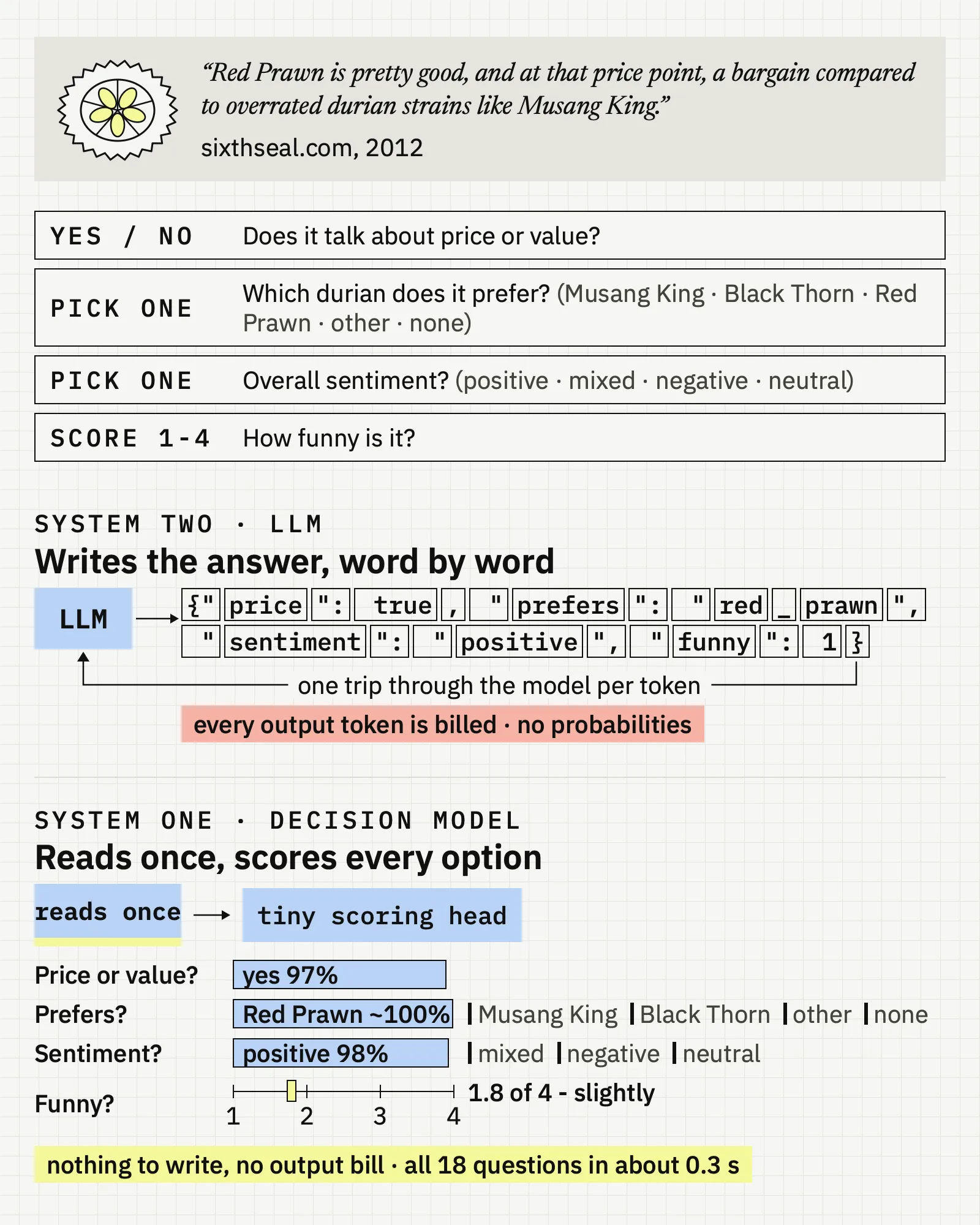
Figure 1: Four of the 18 questions about one durian opinion. An LLM writes its answer token by token; a decision model reads once and returns a probability for every option (Jev’s real answers).
Inside, the open versions are mostly not an encoder with a classifier, but
Why Does It Matter?
Where does it pay off? Wherever you ask the same few questions about a lot of text:
- Comment coding. Sort comments into categories, from Google Maps reviews to employee feedback.
- Risk screening. Spot risks in news articles - easier and cheaper than with an LLM, and a big help for early-warning systems. In one of ours, which checks every article for some twenty risk triggers, a decision model would do the job for
about a hundredth of the cost of a mid-size LLM (our estimate at list prices; the cheapest LLMs come much closer). - Question routing. Send each question in any chatbot to the right agent or tool.
What Happened Since?
- Money. USD 870 million at a USD 7.5 billion valuation (9 October), from Andreessen Horowitz (lead), Sequoia, DCVC (which also led the seed) and angels [9][10].
- OpenAI. Its Decisions API - remember the name - puts GPT-6 Luna behind a typed interface for USD 0.10 per million input tokens; generally available since 22 October, no fine-tuning yet [11][12].
- Rivals. More than 30 [13], from Microsoft (on Alibaba’s Qwen, at Jev’s exact price), Cloudflare and AWS [14][3][4]. On Artificial Analysis’ independent Decision Index, Liquid AI’s d1-ultra (65.2), Subquadratic’s SubQ Snap 1.1 and Baseten’s Elephant 9B lead; Jev 1.14 is fourth (57.1), but among the fastest at about 80 ms per task - while Elephant scores higher at about a fifth of Jev’s price [15].
- Open source. Kev (by Jared Palmer, 0.8B to 27B) [5] and OpenJev (a diffusion model underneath) [16] speak Jev’s API, and Ollama and Pydantic AI support such models [14][17].
- Fine-tuning.
Jev and OpenAI: none - only instructions, option descriptions and thresholds. Open weights: fully - Kev-4B went from 80% to 90% on a complaints task after one pass over 5,219 labels, for about USD 1 of GPU time [5].
Does It Work? A Durian Battle
Nobody is neutral about durians, so I let the models judge 83 real opinions about Musang King (also sold as Mao Shan Wang, D197), Black Thorn (D200) and Red Prawn (D175) from English, Chinese and Malay blogs, forums and news - 18 questions per opinion, in one call: which aspects it mentions and how it feels about them, the overall sentiment, whether it compares durians. Fair warning: a fun experiment, not a rigorous benchmark - 83 short quotes, one run, the expected answers drafted with Claude and checked by me. The data, the MIT-licensed code and a tutorial notebook are on GitHub.
Who Reads Durians Best?
| System | Accuracy | Seconds per opinion | USD per 1M opinions | Confidence to route on? |
|---|---|---|---|---|
| Claude Opus 5.5 (LLM, reference) | 0.95 | 5.1 | ~8,900** | no |
| GPT-6 Luna (LLM) | 0.93 | 3.1 | 88** | no |
| GPT-5.6 Terra (LLM) | 0.92 | 2.3 | 2,109** | no |
| Jev (decision model) | 0.87 | 0.3 | 72 | yes |
| OpenAI Decisions (GPT-6 Luna) | 0.85 | 0.5 | 318 | yes |
| Clef Flash 9B (decision model, local) | 0.84 | 31.1 | free* | yes |
| Kev 4B (decision model, local) | 0.79 | 7.5 | free* | yes |
Accuracy: the mean of four scores against the expected answers. List prices of 24 October 2026; local models ran via Ollama on my MacBook Air.
* No API bill. On a rented AWS GPU (g6.xlarge, one NVIDIA L4, USD 0.80 an hour), we estimate about 0.2 seconds per opinion and USD 50 per million opinions for Kev 4B, and 0.9 seconds and USD 200 for Clef Flash 9B (compute only, without the network trip) - so a self-hosted Kev would be about as fast as Jev and a bit cheaper, though less accurate [18].
** With prompt caching: the instructions and the 18 questions repeat for every opinion, so about 98% of the input costs a tenth of the price - a twentieth for Claude [19][20][21][22]. OpenAI caches automatically; Claude’s caching is opt-in and was off in our run, so the Opus figure is our estimate. Without caching: Luna USD 231, Terra USD 4,974, Opus USD 21,469. The decision APIs can’t do this: Jev has no prompt caching, and OpenAI’s Decisions API caches only the shared text, not the questions [23][12].
- On raw accuracy, the LLM wins: GPT-6 Luna 0.93, Jev 0.87.
- With its confidence, Jev wins.
Send its least confident 15% of answers to review, and 97% of the rest are right (confidence cut: 80%). Luna gets 94.5% of individual answers right, but can’t tell you which 5.5% are wrong (Figure 2). - Ten times faster, a bit cheaper: 0.3 against 3.1 seconds per opinion; USD 72 against 88 per million opinions.
- OpenAI’s version works, but Jev beat it on every count, confidence included:
when OpenAI’s model said it was 80-90% sure, it was right only about half the time . Set the confidence cut for each model separately [17]. - Open models hold up: on my laptop, Clef Flash and Kev-4B scored 0.84 and 0.79 - slow, but private. A local 8B LLM managed only 0.50.
- Malay was the hardest language for everyone.
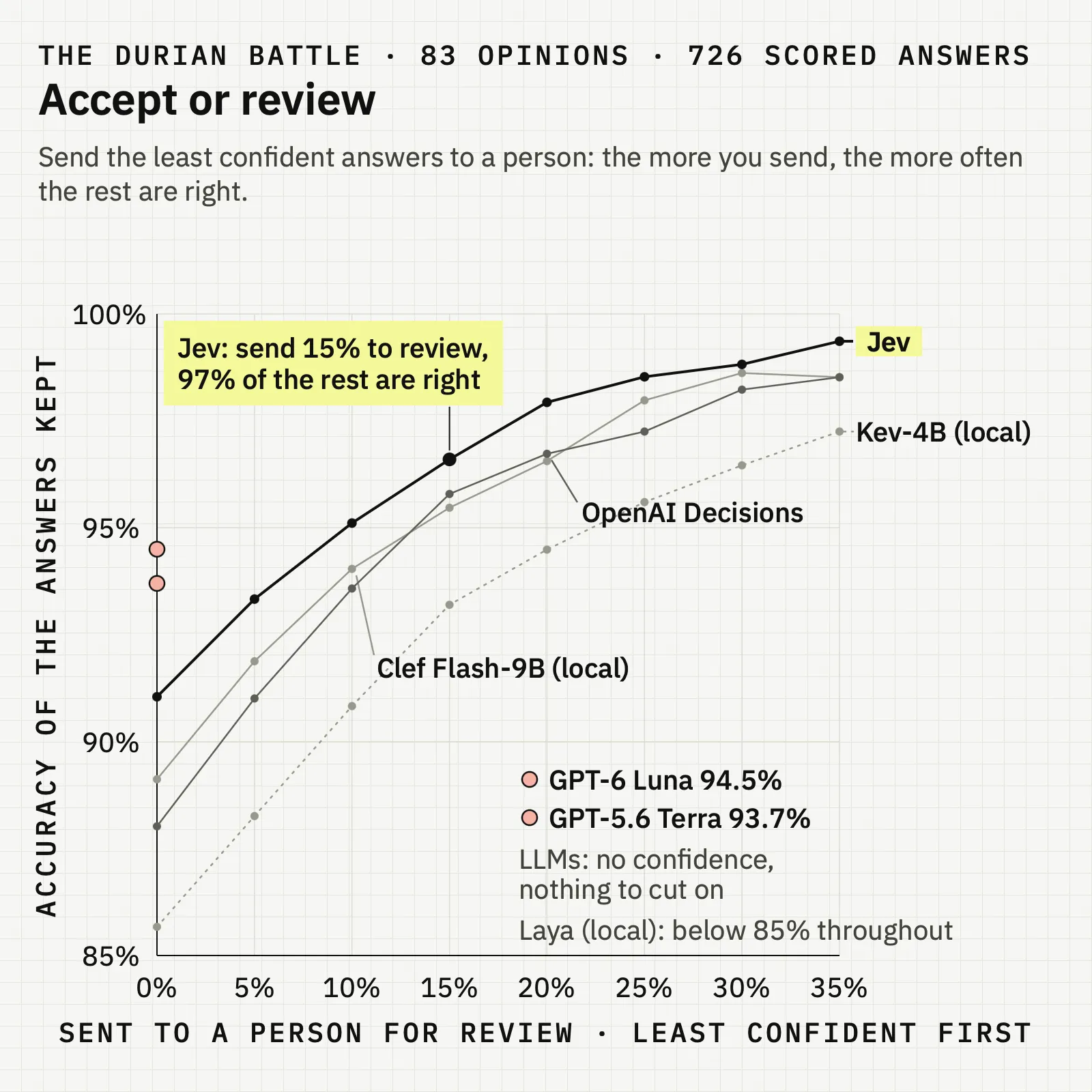
Figure 2: Accept or review. Send the least confident answers to a person, and the rest are right more often - Jev stays on top at every share. The LLMs give no usable confidence, so they can’t play this game.
The Durian Verdict
The people’s Durian Elo - from direct comparisons, writers who tried two durians and every opinion’s score - reads
Its custardy, luscious, in-your-face swagger hits all the right notes hard and fast, like loud orchestral fanfare.
The crown goes to Red Prawn, the cheaper everyday alternative (S$12-18 a kilo in Singapore this June, against about S$20 for Musang King) [25]. Next time, more durians: there are only about 30 species, nine of them edible, but hundreds of named varieties [26]; D24 (Sultan), XO and Black Gold are first in line [27].
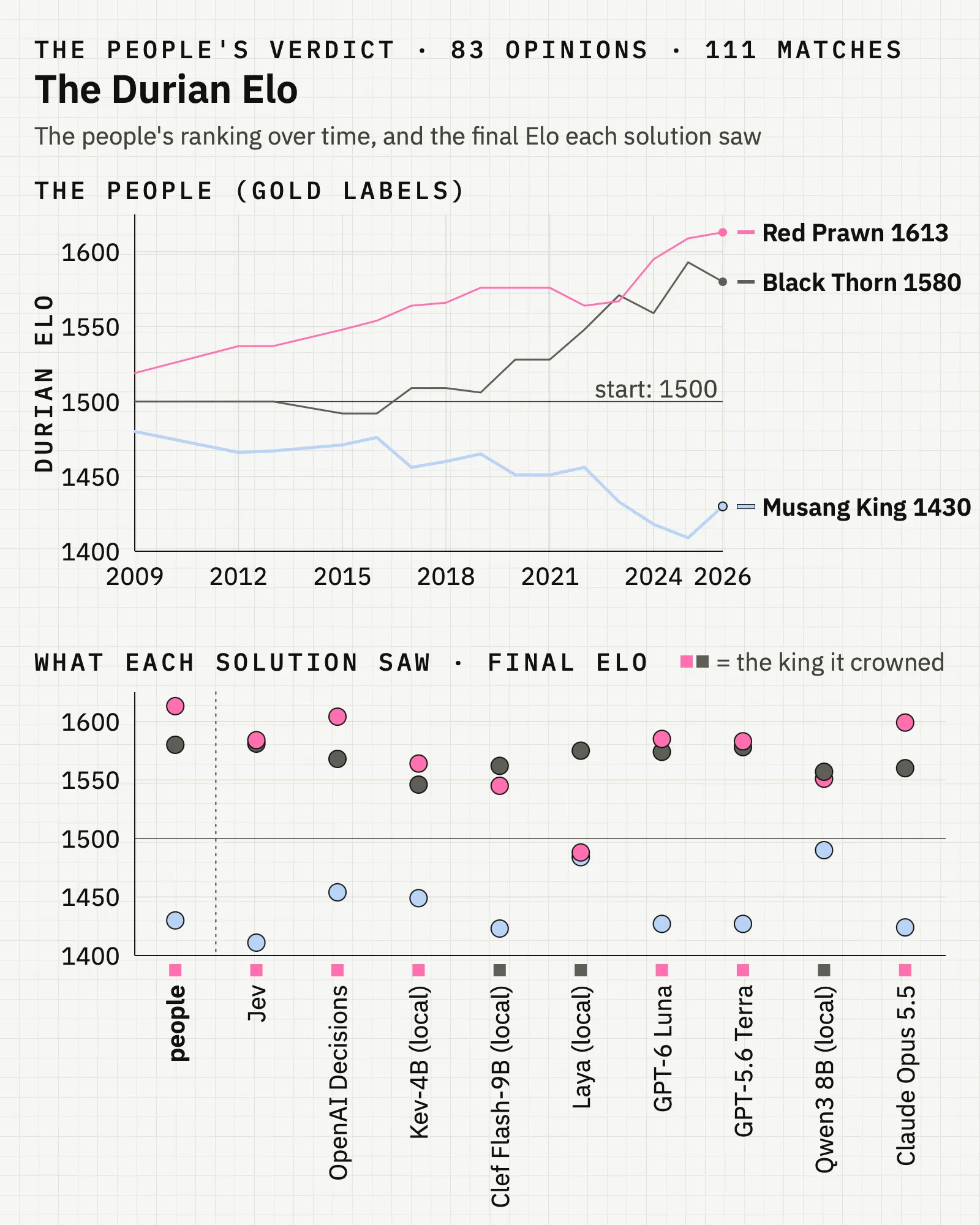
Figure 3: The Durian Elo, 2009-2026. Red Prawn wins the people’s vote; six of the nine AI systems crowned the same king.
My Take
I’d rename them. “Decisions API” suggests the model decides - it doesn’t. It estimates - a risk, a category, a feeling - and says how sure it is. The decision stays with us: accept the confident answers automatically, send the doubtful ones to review. The durians showed exactly that: a bit less accurate than a cheap LLM on its own, Jev was more accurate on the answers it kept - and told us which ones to check. That’s why I prefer TypeSafe’s own label, System One: fast, cheap and a bit shallow, built for routing and pre-filtering. That’s where it will replace LLMs first:
One more lesson from the durians: some decisions you can’t leave to the crowd. The best durian is Musang King, no doubt - and it still came last.
References
- [1] Introducing System One Models and Jev - TypeSafe AI (September 2026).
- [2] System One models for Prod, not God - with Diogo Almeida, CEO, TypeSafe AI - Latent Space (September 2026).
- [3] Introducing Clef: our open-source decision models, and new RL fine-tuning platform - Cloudflare (October 2026).
- [4] AWS launches a local answer to TypeSafe’s Jev decision model - The New Stack (October 2026).
- [5] Introducing Kev - Jared Palmer (October 2026).
- [6] Decision AI Models Explained: TypeSafe Jev vs Fastino GLiDE, GLiNER2.5-Decide and Open-Source Competitors - MarkTechPost (October 2026).
- [7] Jev, A Classification Model, Takes the Developer World By Storm, Spawns Imitators - The Batch, DeepLearning.AI (September 2026).
- [8] TypeSafe documentation: confidence and use cases - TypeSafe AI (read October 2026).
- [9] Jev creator TypeSafe closes $870M round at $7.5B valuation - SiliconANGLE (October 2026).
- [10] Jev Cuts AI Decision Costs 100x And Vercel, Cloudflare Rushed To Add It - Forbes (September 2026).
- [11] OpenAI makes its Jev competitor widely available as decision model competition heats up - TechCrunch (October 2026).
- [12] Decisions guide - OpenAI API docs (read October 2026).
- [13] System One models index - systemonemodels.org (read October 2026).
- [14] Microsoft skipped OpenAI’s decision model and built its own on Alibaba’s Qwen - The New Stack (October 2026).
- [15] Artificial Analysis Decision Index - Artificial Analysis (leaderboard charts of 24 October 2026).
- [16] OpenJev - razorback16 on GitHub (read October 2026).
- [17] System One models - Pydantic AI docs (read October 2026).
- [18] AWS g6.xlarge price, us-east-1 - Holori (data of 23 October 2026).
- [19] Prompt Caching 101 - OpenAI Cookbook (read October 2026).
- [20] GPT-6 Luna model page - OpenAI API docs (read October 2026).
- [21] GPT-5.6 Terra pricing - Requesty (rates of 23 October 2026).
- [22] Pricing (incl. prompt caching) - Claude Platform docs (read October 2026).
- [23] Models - TypeSafe docs (read October 2026).
- [24] Durian season in Singapore: a world beyond mao shan wang - Christopher Tan, The Peak (June 2019).
- [25] How Much Do Popular Durians Cost In Singapore? A 2026 Price Guide - DollarsAndSense (June 2026).
- [26] Durio zibethinus - Wikipedia (read October 2026).
- [27] Here’s The Difference Between D24, Musang King, Black Thorn, XO & Other Durian Types - SAYS (January 2024, updated July 2025).